International news, Local news, News, Politics, Regional News

US Ambassador Offers Advice To Caribbean States

Published: 3 April 2017

St Kitts and Nevis (WINN): St Kitts and Nevis and other Caribbean nations are getting some advice on measures that should be taken in their quest to strengthen their economies.

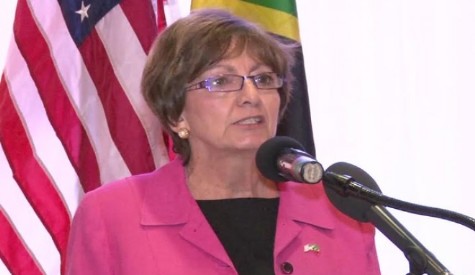
US Ambassador Linda Taglialatela, who heads the American Embassy in Bridgetown, says regional states are having a hard time like the rest of the world.

She is of the view however, that there are measures that can be taken to help islands she labels very proud Caribbean nations move forward economically despite existing hardships.

“Each island needs to have a long term plan, I think first they need to not only look at building additional hotels and attracting more tourism but look at infrastructure. Work on their roads, work on their schools, look at ways to diversify out of the tourism sector. I realize that’s probably the biggest and primary source of revenue but they need to look beyond that. I know that St Kitts and Nevis is looking at geothermal energy, I think they do need to diversify to get their energy costs down and they need to find ways to attract business, both private and foreign investors in their country. There are some issues with youth unemployment which leads to the risk of youths turning to crime, I think you need to address how we’re going to deal with it but I think on a whole, each of them has a plan it’s just a matter getting to the point of implementing.”

Ambassador Taglialatela is expecting continued good relations between the Caribbean and the United States.

“I think that the Caribbean has a lot to offer to the world and has a lot to offer the United States as far as a partnership goes. I think that we will continue to have a good relationship and I think that there has to be a good partnership and collaboration between the United States and the Caribbean. We have over 2 million Americans coming to the Caribbean every year and a number of dual citizens living both in the United States and here in the Caribbean and there will always be a close tie between the two areas.”

Read More...

Crime/Justice, News, Regional News

United Nations Warns Staff in Barbados About Crime

Published: 3 April 2017

BRIDGETOWN, Barbados, Monday April 3, 2017 – The United Nations (UN) has its eye on the crime situation in Barbados, and has issued a security advisory to its staff in the island following a string of recent robberies.

The UN’s Department of Safety and Security (UNDSS) has advised personnel to increase their vigilance following “credible reports that a number of recent robberies are believed to be committed by a group of five armed men”.

It is believed the men are travelling in one vehicle and targeting both businesses and individuals. They attempt to trick victims into stopping or exiting their vehicles by driving behind them and flicking their headlights.

“All UN personnel and family members are reminded to always lock your car doors, keep your windows up, only pull over in well-lit populated areas, and to remain aware of your surroundings at all times. Avoid driving alone at night,” the UNDSS advisory added.

It offered UN employees further advice on how to deal with any such encounter.

“If you detect that you are being watched or followed do not panic and drive to your nearest ‘safe haven’ (UN office, police station…). Try to collect as much information on any suspect vehicle such as make, colour, licence plate, identifying marks, description of occupants, etc. If someone tries to bump your car, honk the horn, put on hazard lights and continue driving quickly,” the UNDSS urged staff.

“If you are hit from behind and have to stop, do not get out of the vehicle or unlock it until you have called the police. Check the mirrors to observe the situation and if you see something suspicious like a pair or group of men descending all at the same time, try to rush to a ‘safe haven’. If you have a driver, instruct him accordingly. It is illegal to leave the spot of an accident but safer to go away straight to the closest police station. The CSFP [Common Foreign and Security Policy] and UNDSS will assist you with the police if necessary.”

Last month, the Royal Barbados Police Force confirmed that it was investigating several crimes which may have been committed by a group of five men travelling in a vehicle.

Read more: http://www.caribbean360.com/news/united-nations-warns-staff-barbados-crime#ixzz4dCkcFLZY

Read More...

Crime/Justice, News, Regional News

Cloud of Suspicion Hangs Over Death of Trinidad Soldier

Published: 3 April 2017

Warrant Officer Omar Samaroo was found slumped in a dormitory at Camp Cumuto, Wallerfield with a gunshot wound to the head. (Photo. Trinidad Express)

PORT OF SPAIN, Trinidad, Monday April 3, 2017 – Questions are being raised and a call for an investigation has been made along with a threat of legal action, following the death of a Trinidad and Tobago Defence Force (TTDF) soldier.

Warrant Officer Omar Samaroo, 47, was found slumped in a dormitory at Camp Cumuto, Wallerfield with a gunshot wound to the head last Tuesday, and died hours later at hospital.

His death was ruled a suicide. But some people aren’t so sure that’s what it was, and Opposition Senator Wayne Sturge says he intends to take legal action if the TTDF does not investigate the circumstances surrounding Samaroo’s death.

In a letter to Chief of Defence Staff Brigadier General Rodney Smart and copied to Attorney General Faris Al-Rawi and National Security Minister Edmund Dillon, Sturge said Samaroo’s death was suspicious, based on his injuries – which he claimed included broken ribs – and how he was found.

He said the public and Samaroo’s family had a right to know whether there was any wrongdoing in his death.

“There should be an effective official investigation when individuals such as officer Samaroo have lost their lives in suspicious circumstances while on duty as a servant and or agent of the State. This officer lost his life while on duty at an army base under your command,” Sturge’s letter to Brigadier General Smart stated, adding that the matter was of “great public importance” that the requires “expeditious action” on the part of the State.

“Should there be no action on the part of the Defense Force and the State in this matter I hereby formally give notice that I shall be challenging the failure of the State to initiate a proper investigation in accordance with my request herein in the High Court in the public interest. I wish to emphasize that the request for the investigation into the death of this officer is not one which ought to be triggered by anyone but one which should have been commenced forthwith by the State in the fulfillment of it substantive and procedural constitutional obligation to the deceased officer.”

However, the TTDF has called on Sturge and other members of the public to desist from making “false and unsubstantiated remarks” about Samaroo’s tragic massing and allow his friends and family members to grieve in peace.

The Defence Force said it “vigorously denounces the flow of misinformation being purported by some conspiracy theorists, in particular by certain ‘responsible’ individuals in society”.

The TTDF also dismissed claims that Samaroo’s body was bruised and that three of his ribs were broken. It said an autopsy confirmed that the soldier, who was a member of the Defence Force for 27 years, died as a result of a single gunshot wound to the head and there were no other marks of violence on his body.

Read more: http://www.caribbean360.com/news/cloud-suspicion-hangs-death-trinidad-soldier#ixzz4dCjwVbhp

Read More...

Local news, News, Politics, Regional News

Hon. Lindsay Grant Attends CARIFORUM Ministerial Consultations in Jamaica

(Times Caribbean) St.Kitts-Nevis Minister of Tourism, International Trade and Industry Hon. Lindsay Grant joined counterparts from throughout Caricom in discussions at two Ministerial consultations of the Caribbean Forum (CARIFORUM) of the African, Caribbean and Pacific Group of States, held in Jamaica.

The first meeting dealt with the Caribbean within the framework of the relations between the European Union and the Community of Latin American and Caribbean States (CELAC). The second will address the future of the African, Caribbean and Pacific Group of States (ACP), as well as the future of the ACP-EU relations after the Cotonou Agreement expires in 2020. Approximately 10 Ministers and 60 senior officials from across the Caribbean participated in the consultations which were held at the Jamaica Pegasus Hotel in Kingston from March 29-30.

The CARIFORUM consultation was held in the context of the ACP Group’s broader reflections on the future direction of the Group, including its relations with the EU. The ultimate aim is to ensure that the ACP Group becomes a more effective global player, with the ability to influence development policy at the global level so that tangible benefits will redound to the peoples of the ACP Member States.

While there is overwhelming support for the continuation of the ACP-EU partnership there is consensus that the ACP must chart its own course and reposition itself in the global arena.

The organisation of the meetings was spearheaded by the CARIFORUM Directorate and the Senator the Honourable Kamina Johnson Smith, Minister of Foreign Affairs and Foreign Trade, in her capacity as Chair of the Caribbean Forum (CARIFORUM) of the African, Caribbean and Pacific Group of States.

Jamaica’s chairmanship of the CARIFORUM commenced last year July and will end June 30, 2017.

Hon. Grant served as Chairman of ACP Council and ACP-EU Joint Council from 1 August 2016 to 31 January 2017.

Note

The Georgetown Agreement was signed in 1975, and created the African, Caribbean and Pacific Group of States (ACP). The group is composed of 79 African, Caribbean and Pacific States. The Caribbean Forum (CARIFORUM) refers to the group of Caribbean ACP States that are signatories to the Georgetown Agreement.

All CARIFORUM States, with the exception of Cuba, are signatories to the ACP-EU Cotonou Partnership Agreement (Cotonou Agreement) and the Economic Partnership Agreement (EPA), respectively.

CARIFORUM States are: Antigua and Barbuda, The Bahamas, Barbados, Belize, Cuba, Dominica, Dominican Republic, Grenada, Guyana, Haiti, Jamaica, St. Kitts and Nevis, Saint Lucia, St. Vincent and the Grenadines, Suriname and Trinidad and Tobago.

Read More...

International news, Local news, News, Regional News

OECS needs a unified approach to development, says economist

http://www.caribbeannewsnow.com/topstory-OECS-needs-a-unified-approach-to-development%2C-says-economist-33951.html #

grenada_forum

The panel at the Grenada Forum

Published on March 30, 2017

ST GEORGE’S, Grenada — The biggest impediment to growth of the economies of the Organisation of Eastern Caribbean States (OECS) is their small size and scale of production, and the lack of a unified regional approach to development. That’s the view of Dr Vanus James, economist, statistician and regional academic in remarks at the OECS Economic Growth Forum in Grenada on Friday, March 17, 2017.

Citing tertiary education as one of the growth sectors with the greatest potential for growth, James singled-out Grenada (St Georges University) as well as Antigua, as leading in tertiary education in the OECS. He believes that model must now be replicated across the OECS, in other growth sectors such as the creative industries and the ICT sector, identifying skills gaps and helping to attract foreign investment through a regional approach.

The Grenada forum was the final in the public education forum series – Vini Koze – which engaged citizens of the OECS on key development issues such as education, climate change, agriculture, youth empowerment, and regional integration.

James, who has worked as a senior policy advisor to the United Nations Development Programme (UNDP), said with very slow growth in large economies such as the United States, Canada and Europe, which are major source markets for our tourism industry as well as buyers of our exports, the region is at a critical juncture in terms of its economic fortunes.

He said these developed countries and traditional allies, are all threatening to close their economies and reduce imports from the region, a factor he said can “negatively affect our ability to increase our exports, which is what we need as small countries, in order to raise our rate of growth.”

James suggested that “for the first time, countries of the Eastern Caribbean are at a juncture where they are confronted with the challenge of how to diversify their economies away from tourism, in the context of slow growth and falling imports in the North Atlantic.”

“At this moment in our history, we must create new types of exports by building our domestic capital sector. That’s the most historic challenge we’ve ever faced, from Slavery to now. How to do we create capital with our own capabilities. In that regard, we need new thinking about how to grow our economies.”

James feels very strongly that the region needs to return to the growth strategies used before globalisation.

He explained: “We import most of the assets we use to produce, but if you want to engage the world, you have to build domestic capability, to create demand in the world for the things we export. We must build-up our domestic capital sector. The fundamental problem we have in the Caribbean is that our domestic sector is too small. We’re not doing enough with the creative industries. We’re not doing enough with ICT as exports. And we’re not doing enough with tertiary education as an export. To engage with the changing world, we must change the type of exports we offer by building our domestic capital sector.”

James is adamant that in order to build the domestic capital sector, “we have to confront the historical inequalities in our societies, including the unequal access to power.” He asserted that the people who get access to power and who shape policy in the region, are a select few who have always had access to the levers of power, and who have not invested well in our domestic capabilities.

Consequently, he recommended major reform in governance in the OECS and the wider Caribbean. He called for participatory budgeting at the national level and joint policy-making, both of which would ensure more people involvement and people participation in governance.

Oliver Joseph, minister for economic development, said the government of Grenada is taking steps to ensure more citizen engagement in national budgeting.

He explained: “In the preparation of our National Budget in Grenada, we have consultations where we go throughout the island to get the views of farmers, the youth, and all stakeholders, to hear what they would like to see in the budget and what initiatives they would like the government to pursue at the community and national level.”

Grenada has just come to the end of a homegrown structural adjustment programme from which it received a passing grade from the International Monetary Fund (IMF), following a recent country assessment with significant reduction in its debt to GDP ratio from 60 percent to 40 percent.

Joseph contended: “The only reason we have been so successful is because we continue to listen to our social partners in shaping and implementing national policy. The success we have achieved is because of the participation and ‘buy-in’ we have had from the people.”

In relation to the issue of rising youth unemployment in OECS member states, Joseph said the era of government being the largest employer is coming to an end. He said the approach should be for government to give incentives to the private sector and seek to attract foreign direct investment to create jobs.

Joseph disclosed that in 2016, Grenada spent EC$30 million on training of young people through the Grenada Training Institute, where they attained CARICOM Vocational Qualification (CVQ) in various skilled areas. He said this training is designed to provide young people with the tools to create their own employment or to secure jobs in the specialized areas in which they are trained.

As it relates to diversifying Grenada’s economy, Joseph says the Economic Commission for Latin America and the Caribbean (ECLAC) has just completed a study of the non-tourism services sector which will guide government policy as it relates to the incentives and skills needed to grow these sectors.

President of the St Lucia Hotel & Tourism Association, Sanovnik Destang, believes there is scope to expand the contribution of tourism to the economies of the OECS.

He told the forum: “The tourism sector has seen tremendous growth in recent years. We had some rough years in 2008, 2009, and 2010, but we’ve seen steady growth since then. ”

Destang believes the time has come to broaden the contribution of tourism to GDP beyond arrival figures. He notes that visitor expenditure has a major trickle-down effect in the local economy, and there are millions of dollars to be gained from strengthening linkages between tourism and other sectors such as agriculture. On the home front, the SLHTA has teamed up with local farmers in setting-up a Virtual Agriculture Clearing House (VACH).

Destang said this initiative has seen a significant increase in the purchase and use of local produce by hotels in Saint Lucia. He says the system is so advanced, that an app has been developed to forecast the production cycles of farmers to match demand from the hotels.

The public education forum series is part of the public education component of the Economic Integration and Trade Programme of the OECS region, funded by the 10th European Development Fund. It is being produced by ElShaFord Productions on behalf of the OECS Commission. The series will be edited for broadcast across all OECS member states, the wider Caribbean, and the West Indian diaspora in the UK, the USA, and Canada.

Read More...