Business, Entertainment, News, Regional News

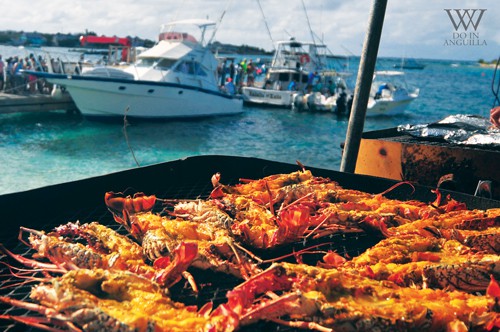
Anguilla’s Festival Del Mar, the Caribbean’s best seafood festival

2016 Festival Del Mar crayfish
Published on March 29, 2017

THE VALLEY, Anguilla — One of the premier culinary festivals in the Caribbean, the tenth annual Festival Del Mar in Anguilla, is a must for any foodie – especially those with a penchant for seafood. Local lobster features prominently, as do crab, crayfish, octopus (sea cat), fried fish, and grilled fish of many varieties.

Festival Del Mar, celebrated on Easter weekend, commemorates Anguilla’s seafaring heritage and celebrates all things of the sea in the beautiful fishing village of Island Harbour, located on the eastern tip of the island. This little fishing village has remained largely untouched by tourism and still maintains its local vibe, with colorful boats bobbing in the blue harbor and a fishing pier jutting out to catch schooners and fishing boats, much as it was in the early 1900s.

Traditional cooking and culinary competitions, deep sea fishing competitions, swimming races, volley ball exhibitions and crab races are all “on the menu” for this fun-filled celebration, along with two days of live music and boat racing, the island’s national pastime. This year will see the addition of a water park, which will add to the fun, along with a wading pool for children.

The atmosphere is casual and visitors are invited to wear their swimsuits in case they want to take a dip in the sea. There are also plenty of tented areas for lounging out of the sun and domino games are played throughout the afternoons. The musical headliner will be gospel and country artist Pat Ross who has drawn crowds to the festival in previous years.

Festival Del Mar serves a dual purpose, providing the Anguillian people with the opportunity to celebrate their rich history and offering visitors a window into Anguilla’s unique cultural traditions.

Read More...

Business, Local news, Regional News

Feasibility study confirms geothermal potential of St Kitts

Published on March 29, 2017

geothermal_feasibility

At the meeting, from left Joseph Williams; Dr Devon Gardner; Dr Vince Henderson; Ian ‘Patches’ Liburd; Jacques Chouraki

BASSETERRE, St Kitts (SKNIS) — A feasibility study done by Teranov, a French engineering and services company for new and renewable energy based in Guadeloupe, has confirmed that there is potential in St Kitts to develop at least 18 to 36 megawatts of geothermal power.

Speaking at the conclusion of a two-day meeting of geothermal stakeholders in St Kitts from March 21- 22, minister of public infrastructure, Ian ‘Patches’ Liburd, hailed the findings as “heartening” but that the government has to consider the way forward.

Liburd said that the meeting was convened with other stakeholder representatives including Dr Vince Henderson, ambassador of Dominica to the United States; Jacques Chouraki, president of Teranov; Dr Devon Gardner, programme manager for energy at the Caribbean Community (CARICOM) Secretariat; Joseph Williams, sustainable energy advisor at the Caribbean Development Bank (CDB); representatives from the St Kitts Electricity Company Ltd (SKELEC), ministry of finance, Office of the Attorney General, and private sector “as it relates to solidifying our roadmap in respect of our geothermal development here on St Kitts and in Nevis with particular focus on the development on St Kitts.”

“We have so far done the 3G studies — the geological, geophysical and geochemical studies or the surface studies… there is potential on St Kitts to develop at least 18 to 36 megawatts of geothermal power and that’s heartening for us here in St Kitts and Nevis,” said Liburd, while indicating that the next step is to consider the way forward for slim-hole and exploration drilling.

Liburd said that the government received a draft geothermal agreement from its partners for which Cabinet decided that there should be an independent review. According to the minister, the government consulted with the CARICOM and the CDB.

“Where we are right now in terms of the next steps, next set of actions and timelines, we have agreed today that we would restructure the geothermal agreement and we have put a timeline on that to be completed by the end of June this year. We also have agreement in terms of the provision of a business plan and financial model from Teranov. We would in terms of the joint venture company arrangements consider the shareholder agreement issues that deal with decision-making; and the commercial issues are key business points in some reform and indeed we did agree on the way forward as it relates to… development of this resource on St Kitts,” Liburd said.

He said it was necessary to have further discussions because any agreement signed off on has to bear in mind that government owns the land, the utility called SKELEC and the government will own the resource.

Liburd said that whatever comes out of the agreement has to “ensure we protect the best public interest” and “there must be real benefit for the end consumer.

In November 2015, Teranov began geothermal exploration exercises in the Sandy Point area around Brimstone Hill, going to the top of Mount Liamigua. Five geo-scientists were in St Kitts conducting feasibility studies in geophysics, geology and geochemistry.

President of Teranov, Jacques Chouraki, said then that the prospects for geothermal energy on St Kitts were promising.

In September 2015, Liburd signed a memorandum of understanding (MOU) with Teranov, which includes a road map that can possibly see the production of geothermal energy in 2020.

Liburd has underscored the point that fossil fuel costs are very exorbitant and that “if we are going to continue our development and if we are going to ensure economic growth” that the government must adopt a policy of renewable energy because “we are blessed with sunshine, we are blessed with wind and in the federation of two islands we have two volcanoes.”

Read More...

Business, Crime/Justice, International news, Local news

US slams St Kitts-Nevis in money laundering and financial crimes report

Published on March 29, 2017

By LK Hewlett

BASSETERRE, St Kitts (WINN) — A US State Department report claims that St Kitts and Nevis “remains susceptible to corruption and money laundering and its deficient vetting of citizenship by investment candidates is also problematic”.

The scathing report, released in March, attributes the country’s susceptibility to corruption and money laundering to “the high volume of narcotics trafficking around the islands”.

On the matter of alleged weaknesses with the St Kitts and Nevis citizenship by investment (CBI) program, the State Department said, “St Kitts and Nevis derives a significant portion of its revenue from its program offering citizenship through investment; however, this program’s prior lax vetting created anti money laundering and security vulnerabilities domestically and internationally. Despite recent efforts to improve the application process and vetting procedures, the CIP continues to be afflicted by significant deficiencies in vetting candidates and conducting due diligence on passport and citizenship recipients after they receive citizenship.”

The report went on to charge that St Kitts and Nevis did not report passage of new enforcement legislation or prosecutions in 2016, and there have been no money laundering prosecutions or convictions since 2013.

The US government did acknowledge the fact that its Financial Crimes Enforcement Network (FinCEN) is engaging St Kitts and Nevis to evaluate if recent CBI improvements sustainably address US anti-money laundering and countering financing of terrorism concerns.

The report was also critical of the offshore sector in Nevis, saying financial oversight in Nevis remains problematic due to the federation allowing the creation of anonymous accounts, strong bank secrecy laws, and overall lack of transparency of beneficial ownership of legal entities.

It read, “The ambiguous regulatory framework regarding customer due diligence makes Nevis a desirable location for criminals to conceal proceeds.”

The US government advised that the government of St Kitts and Nevis should work toward transparency and accountability in financial regulation; and promote close supervision of the CBI program and be transparent in reporting monitoring results.

Republished with permission of West Indies News Network

Read More...

Business, International news, News

OECS needs a unified approach to development, says economist

ST GEORGE’S, Grenada — The biggest impediment to growth of the economies of the Organisation of Eastern Caribbean States (OECS) is their small size and scale of production, and the lack of a unified regional approach to development. That’s the view of Dr Vanus James, economist, statistician and regional academic in remarks at the OECS Economic Growth Forum in Grenada on Friday, March 17, 2017.

Citing tertiary education as one of the growth sectors with the greatest potential for growth, James singled-out Grenada (St Georges University) as well as Antigua, as leading in tertiary education in the OECS. He believes that model must now be replicated across the OECS, in other growth sectors such as the creative industries and the ICT sector, identifying skills gaps and helping to attract foreign investment through a regional approach.

The Grenada forum was the final in the public education forum series – Vini Koze – which engaged citizens of the OECS on key development issues such as education, climate change, agriculture, youth empowerment, and regional integration.

James, who has worked as a senior policy advisor to the United Nations Development Programme (UNDP), said with very slow growth in large economies such as the United States, Canada and Europe, which are major source markets for our tourism industry as well as buyers of our exports, the region is at a critical juncture in terms of its economic fortunes.

He said these developed countries and traditional allies, are all threatening to close their economies and reduce imports from the region, a factor he said can “negatively affect our ability to increase our exports, which is what we need as small countries, in order to raise our rate of growth.”

James suggested that “for the first time, countries of the Eastern Caribbean are at a juncture where they are confronted with the challenge of how to diversify their economies away from tourism, in the context of slow growth and falling imports in the North Atlantic.”

“At this moment in our history, we must create new types of exports by building our domestic capital sector. That’s the most historic challenge we’ve ever faced, from Slavery to now. How to do we create capital with our own capabilities. In that regard, we need new thinking about how to grow our economies.”

James feels very strongly that the region needs to return to the growth strategies used before globalisation.

He explained: “We import most of the assets we use to produce, but if you want to engage the world, you have to build domestic capability, to create demand in the world for the things we export. We must build-up our domestic capital sector. The fundamental problem we have in the Caribbean is that our domestic sector is too small. We’re not doing enough with the creative industries. We’re not doing enough with ICT as exports. And we’re not doing enough with tertiary education as an export. To engage with the changing world, we must change the type of exports we offer by building our domestic capital sector.”

James is adamant that in order to build the domestic capital sector, “we have to confront the historical inequalities in our societies, including the unequal access to power.” He asserted that the people who get access to power and who shape policy in the region, are a select few who have always had access to the levers of power, and who have not invested well in our domestic capabilities.

Consequently, he recommended major reform in governance in the OECS and the wider Caribbean. He called for participatory budgeting at the national level and joint policy-making, both of which would ensure more people involvement and people participation in governance.

Oliver Joseph, minister for economic development, said the government of Grenada is taking steps to ensure more citizen engagement in national budgeting.

He explained: “In the preparation of our National Budget in Grenada, we have consultations where we go throughout the island to get the views of farmers, the youth, and all stakeholders, to hear what they would like to see in the budget and what initiatives they would like the government to pursue at the community and national level.”

Grenada has just come to the end of a homegrown structural adjustment programme from which it received a passing grade from the International Monetary Fund (IMF), following a recent country assessment with significant reduction in its debt to GDP ratio from 60 percent to 40 percent.

Joseph contended: “The only reason we have been so successful is because we continue to listen to our social partners in shaping and implementing national policy. The success we have achieved is because of the participation and ‘buy-in’ we have had from the people.”

In relation to the issue of rising youth unemployment in OECS member states, Joseph said the era of government being the largest employer is coming to an end. He said the approach should be for government to give incentives to the private sector and seek to attract foreign direct investment to create jobs.

Joseph disclosed that in 2016, Grenada spent EC$30 million on training of young people through the Grenada Training Institute, where they attained CARICOM Vocational Qualification (CVQ) in various skilled areas. He said this training is designed to provide young people with the tools to create their own employment or to secure jobs in the specialized areas in which they are trained.

As it relates to diversifying Grenada’s economy, Joseph says the Economic Commission for Latin America and the Caribbean (ECLAC) has just completed a study of the non-tourism services sector which will guide government policy as it relates to the incentives and skills needed to grow these sectors.

President of the St Lucia Hotel & Tourism Association, Sanovnik Destang, believes there is scope to expand the contribution of tourism to the economies of the OECS.

He told the forum: “The tourism sector has seen tremendous growth in recent years. We had some rough years in 2008, 2009, and 2010, but we’ve seen steady growth since then. ”

Destang believes the time has come to broaden the contribution of tourism to GDP beyond arrival figures. He notes that visitor expenditure has a major trickle-down effect in the local economy, and there are millions of dollars to be gained from strengthening linkages between tourism and other sectors such as agriculture. On the home front, the SLHTA has teamed up with local farmers in setting-up a Virtual Agriculture Clearing House (VACH).

Destang said this initiative has seen a significant increase in the purchase and use of local produce by hotels in Saint Lucia. He says the system is so advanced, that an app has been developed to forecast the production cycles of farmers to match demand from the hotels.

The public education forum series is part of the public education component of the Economic Integration and Trade Programme of the OECS region, funded by the 10th European Development Fund. It is being produced by ElShaFord Productions on behalf of the OECS Commission. The series will be edited for broadcast across all OECS member states, the wider Caribbean, and the West Indian diaspora in the UK, the USA, and Canada.

Read More...

Business, News, Regional News

Guyana may be just weeks away from economic crisis, says economist

Published on March 30, 2017

By Dennis Adonis

GEORGETOWN, Guyana — Having narrowly missed the economic after-effects of the 2008 Wall Street financial crash (the global financial crisis), and surviving a 2014 potential FOREX slide (since it is on the list of nations that could have suffered collateral damage from the 2014 oil slump); Guyana’s economic luck might be running out this time around.

At least this is the view of three respected financial experts, including a former World Bank economist, who predicted that Guyana may be weeks away from finding itself in the face of a recession demon that is similar to the ones that have been haunting neighbouring Venezuela, and Suriname among others, for some time now.

From experiencing a suddenly volatile currency exchange rate, stagnant economic growth, declining foreign investments, and a growing unemployment problem, Jeremy Blaine, a leading economic analyst at Accenture and a former World Bank consultant, told the Guyana Guardian that these are clear indicators that the writing is already on Guyana’s wall.

He noted that the government might have been caught in the middle of a spin-off from the underground economy that could have been brewing since the 2008-2009 global financial crisis, but which could have been made worse by current poor economic and social governance decisions.

In his opinion, a currently poor economy policy, a growing anti-investment climate, and a string of misguided taxation measures are taking a reverse toll on the country’s private sector, while the population’s spending power has been significantly reduced, to the detriment of the country’s overall economic outlook.

The economist stressed that one of many examples will be the poorly advised abrupt closure of sections of the sugar industry, which has since starved the economy of billions of dollars of surplus money that was previously being injected into the ailing sector from the treasury.

He reiterated that, even though government surpluses (such as the billions of dollars that were previously being injected into Guysuco) can indeed be an irritant to the treasury, it can actually turn out to be a blessing to the economy if the surplus money is going directly to the thousands of workers whose households would usually triple into thousands of consumers.

He further explained that in that way the surplus money ensures that the economy itself is being propped up, as the cash would usually spreads itself out across various commercial sectors.

Hence pulling that five billion dollars or so per year in budgetary surplus from Guysuco would mean pulling an average of $12 million per day from the extended economy.

And in such a case this will amount to reduced consumer spending power, reduced commercial income, and a reduction in tax intake.

Therefore, he is suggesting that government immediately take certain measures to increase consumer spending power, and to also create large scale employment opportunities.

“Unless the government can swiftly cut consumer taxes, offer direct foreign investment concessions, increase lending and spending via a central bank created digital currency which can substitute as a multi-billion dollar stimulus package, cut bank lending interest rates, hold off on closing down the sugar estates, re-engage migrating foreign investors such as Bai-Shanlin, and temporary insure certain classes of consumer credit, a recession will be imminent for Guyana,” he said.

While a string of recessions has been hitting the global economy hard, Guyana among several other countries was initially able to stave off the recession curse from hitting their shores.

But with several untested changes in government’s economic policy as of last year, a loss of several foreign export markets, and an increase in the global stranglehold on funding from several major donor countries, Guyana along with other nations has been losing out to direct foreign investments, investor created jobs, and needed foreign exchange, on a large scale.

For example, during the latter part of 2016, controversial Chinese company Bai ShanLin, and the Malaysian-owned Barama Company Ltd, began winding down their operations in Guyana, which has since seen just over 400 Guyanese directly and indirectly losing their jobs.

And with a handful of sugar estates facing closure, while certain agricultural sectors such as rice are being stifled by a limited export market, the government seems to be underestimating the potential economic woes that may be in waiting.

But as for an impending recession, many are doubtful that it is an experience that Guyanese may be prepared for.

However, many are still hoping that the government will initiate emergency measures that will be aimed at preventing a full-blown economic fall-out.

Republished with permission of the Guyana Guardian

Read More...